Copyright © All Rights Reserved

The "Scilla Method"
Traditional didactics mediate the knowledge of music and instrumental performance through the linguistic-cognitive aspect to which the scheme [grapheme - phoneme - word - meaning] is applied. By verbally decoding the musical note, the semantic memory of the explicit system is activated. Since the decoding of the grapheme into a phoneme and vice versa is deficient in dyslexic children, this creates problems both in reading and in musical performance. This also creates difficulty in reading for children who do not have dyslexia problems, decreasing reaction times and prolonging assimilation times.
Music, however, is a set of sounds that have a certain frequency and duration, so they cannot be treated as 'words' and cannot be taught as such. This is because the note written on the staff is not primarily a phoneme but a sign that indicates and evokes a precise frequency with a certain duration. Its key to reading, therefore, is to bring to light, in sound memory, the same note with that frequency and duration.
Whereas music theory, that is, the knowledge that explains the meaning of the written sign, is the knowledge that refers to the semantic memory of the explicit system and has access codes compatible with this type of knowledge. Music, which is the art of sounds, that is, the knowledge that produces sound, whether vocal or instrumental it does not matter, is knowledge that refers to the implicit system of procedural memory that is primary in the action of playing.
This is feasible because in my method the process of learning to play the violin is not a process of acquiring an action external to us, but a process of recovering an internal act that is already part of our knowledge but is not conscious.
For more information please contact: info@dsaviolino.com
For more information about my activity as a music composer, please consult: www.scillasimona.com or contact info@scillasimona.com
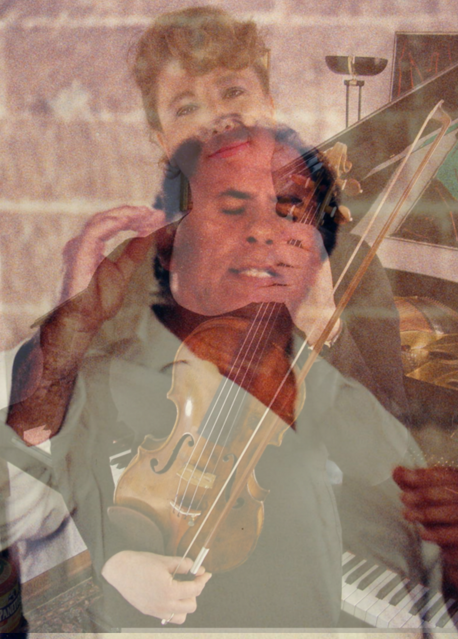
Osvaldo and Simona Scilla
The "Scilla Method"